

How We Stop Passing Student Loan Debt to the Next Generation
Growing up, I knew no one was coming to save me. Maybe it’s a military kid thing. I knew early on that if I wanted a different future, the only way forward was through hard work, grit, and education.
There was no college fund waiting for me. No one co-signing student loans or taking out parent plus loans. No extra gas money. No parent cell phone plan. I started babysitting in 6th grade, lifeguarding at 14, and by my sophomore year of college, I was working two full-time jobs while trying to stay afloat academically.
And like so many students in the early 2000s, I signed the student loan paperwork because it felt like the only option. I’ve been paying on those loans ever since (and nearly finished!).
Do I regret it? Not for a second.
Those loans opened doors that changed the trajectory of my life. They changed my earning potential, my opportunities, and ultimately the quality of life for my children. And maybe MOST importantly, they broadened by perspective of the world around me.
But if I’m being honest? I wish I had been given the opportunities today’s students have - especially the ability to earn meaningful college credits while still in high school.
So this post is for the parents (and students!) staring down the cost of college and wondering how on earth they’ll afford it someday.
Because I know there is a better way.
First, let me say this clearly: I do not think college is for everyone. But I do think post-secondary education - whether that’s a trade, certification, community college, or university - should be accessible to anyone who wants it.
And right now, families have opportunities available that many of us never did.
So, let’s begin
Over the last 30 years, average tuition costs at public and private universities have essentially doubled after adjusting for inflation. And when you start running the numbers as a parent? It can feel downright terrifying.
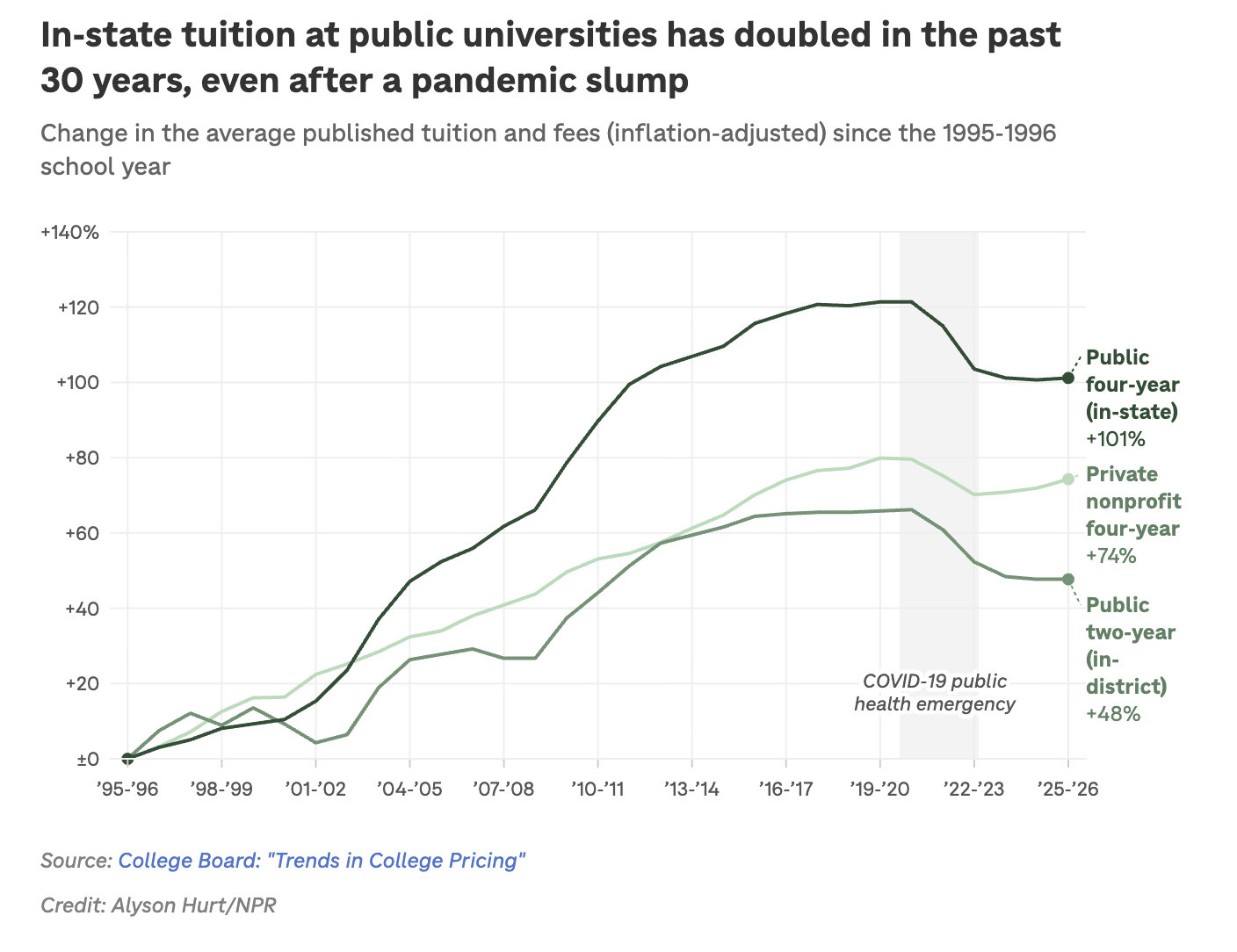
The average public university cost for tuition, room, and board hovers around $22,000 per year. Multiply that by four years, and suddenly a bachelor’s degree can easily approach $90,000 before interest.
Even if your student skips dorm life and lives cheaply, tuition alone can still cost over $40,000 for a four-year degree at a public university. (Not to mention, who’s paying rent and living expenses).
And here’s the part many families don’t realize until it’s too late:
Federal student loan limits often don’t even cover the full cost of attendance. (See new loan limits here)
That leaves students and parents trying to bridge the gap through:
private loans
Parent PLUS loans
multiple jobs (and added stress)
credit cards
or simply taking on unsustainable debt
I’ve lived that reality. It’s exhausting. So what’s the alternative?
Concurrent Enrollment + Discipline
What if I told you that setting aside roughly $10 a week starting in kindergarten could realistically cover the cost of your child earning an Associate of Arts degree — or at least completing the majority of their general education credits — before they even graduate high school? Or within 1 year post high shcool graduation?
Not through a complicated investment strategy.
Not through winning scholarships (use those for that bachelor’s degree!)
Not through having a massive income.
Not through parent plus loans.
Just through planning, consistency, and fully utilizing concurrent enrollment opportunities AND 1 less drive through coffee or 1 less take out a month!
The Opportunity Most Families Overlook
Many Iowa high schools now offer extensive concurrent enrollment and dual credit opportunities through local community colleges like Ellsworth Community College via the Senior Year Plus Program.
In our district, students can graduate high school rather easily, in my opinion, with 30+ college credits already completed toward an Associate of Arts degree.
For perspective:
An AA degree through Ellsworth Community College requires 64 credit hours
If a student earns 38 credits during high school, that leaves only 26 credits remaining
note that Iowa schools can charge a $35 per class textbook fee under specific circumstances, but that’s much better than the tuition rate per credit hour!
Those remaining credits can be completed during:
the summers in between 8th-fresh, fresh-soph, soph-junior, junior-senior years
OR post-graduation if they don’t want to pack so many classes in.
That means your child could potentially:
graduate high school nearly halfway through college
finish an AA degree before age 19 or 20
transfer into a four-year university as a junior
cut years off student loan repayment including interest.
Let’s Talk Numbers
Current tuition at ECC is approximately: $229 per credit hour
If your child only needs approximately 26 remaining credits, the total out-of-pocket cost becomes:
26 credits × $229 = $5,954
Add books and fees, and you’re realistically looking at ballpark:
$7,000-ish total
That’s it.
Not per semester.
Not per year.
Total.
Breaking It Down Weekly
If you started saving in kindergarten:
$10/week = $520/year
Over 13 years (K–12) = $6,760
That’s essentially the cost of finishing those remaining college credits outright.
A couple skipped drive-thru coffees or gas station donuts each week.
One less family dinner eating out each month.
A small automatic transfer into savings. (Hint: Put it into a 529 plan for tax advantages, or even a high-yield savings account if you want flexibility +interest earned.)
That tiny habit could save your child from years - or decades - of loan payments. And honestly? doesn’t that seem far more achievable than trying to magically come up with tens of thousands of dollars later. Consecutively. For multiple kids?
Compare That to Traditional University Costs
Now compare that affordable pathway to attending a four-year university for those same first two years.
Using current tuition estimates from Iowa State University:
Tuition Only (2 Years)
Tuition cost: $21,574
Deferred interest accrued: $1,466
Total repaid over 5 years at 6.8% interest: $26,716
Total repaid over 10 years at 6.8% interest: $31,448
Including Room & Board
Estimated total cost: $44,590
Deferred interest accrued: $3,030
Total repaid over 5 years: $55,218
Total repaid over 10 years: $64,999
The Difference Is Life-Changing
By utilizing concurrent enrollment and finishing general education requirements affordably through a community college pathway, families could save approximately:
$13,000 to $50,000+
Depending on housing choices, repayment terms, and interest. And that’s not just “saving money.”
That’s:
reducing financial stress
allowing earlier homeownership
helping young adults invest sooner
creating more career flexibility, early retirement options, improved work-life balance
and changing generational wealth trajectories
Because when young adults aren’t drowning in debt payments, they can start building wealth years ahead of their peers.
Community College Is Not “Settling”
There’s still an outdated stigma around community colleges, but the reality is this:
Your child’s English Composition credit transfers the same whether it was earned at a university campus or through concurrent enrollment in high school.
Your future:
nurse
teacher
engineer
accountant
therapist
or business owner
still ends up with the same bachelor’s degree.
The difference is whether they start adulthood buried under debt.
What This Looks Like for Families
Imagine your child:
graduates high school with over a semester (or more) of college already done
finishing an AA degree affordably
transfers to a university as a junior
graduates earlier, or gets that Master’s degree for the cost of a Bachelor’s!
pays dramatically less in tuition
possibly avoids student loans altogether
All because you started setting aside $10 a week when they were five years old.
That’s the power of small, consistent decisions over time.
That’s how we begin changing generations. That’s how we strengthen families. That’s how we shape communities.
The two questions I hear most often are:
“But aren’t you robbing your child of the college experience?” and “What are they even supposed to do at 19 with an associate degree?”
Respectfully… what?
The “college experience” shouldn’t just be code for debt, stress, and spending two extra years paying premium prices for general education credits. The real college experience is learning how to think critically, manage your time, meet new people, challenge yourself, explore interests, and grow into adulthood.
And I hope our kids continue doing those things every single day for the rest of their lives.
Learning doesn’t stop after high school. It doesn’t stop after college either.
And if your child finishes an associate degree at 19 with little to no debt? Amazing. Keep going, sis or bruh- whatever the cool kids are saying.
Go earn the bachelor’s degree. Pursue the master’s. Chase the doctorate. Study abroad. Transfer to the dream school. Start the business. Take the internship. Buy the plane ticket. Volunteer somewhere meaningful. Invest early. Build a life with options instead of limitations.
Or maybe they realize college isn’t the path they want at all - and now they’ve figured that out without being buried under tens of thousands of dollars in student loans.
That’s not robbing kids of opportunity.
That’s giving them more of it. I’ll die on that hill.
Most importantly, start the conversation early.
Talk with your school district. Ask questions about concurrent enrollment eligibility, available course offerings, and transferability of credits (Not everyone wants or needs an AA degree!). Every district is a little different, and programs continue to evolve. (We started with a spreadsheet in 8th grade that looked like this, and reviewed and have adapted every semester since.)
Then sit down with your child and their school counselor to create a flexible four-year plan. Not a rigid one. Not a pressure-filled one. A flexible roadmap that leaves room for growth, changing interests, sports, activities, jobs, mental health, and simply being a kid.
Because while these opportunities can be incredible, they should never come at the expense of your child’s well-being or happiness. Above all else - always, ALWAYS consider your student’s wishes.
Some students will thrive with a packed concurrent enrollment schedule. Others may want a more traditional high school experience. Some may pursue trades, certifications, military service, entrepreneurship, or careers that don’t require a degree at all.
The goal is not to force every child into the cheapest or fastest path.
The goal is to help them enter adulthood with opportunity, confidence, and as little financial burden as possible while still honoring who they are and who they want to become.
Because at the end of the day, success does not look the same for every student. But giving our kids options? Giving them support? Giving them a head start without drowning them in debt?
That’s something worth planning for.